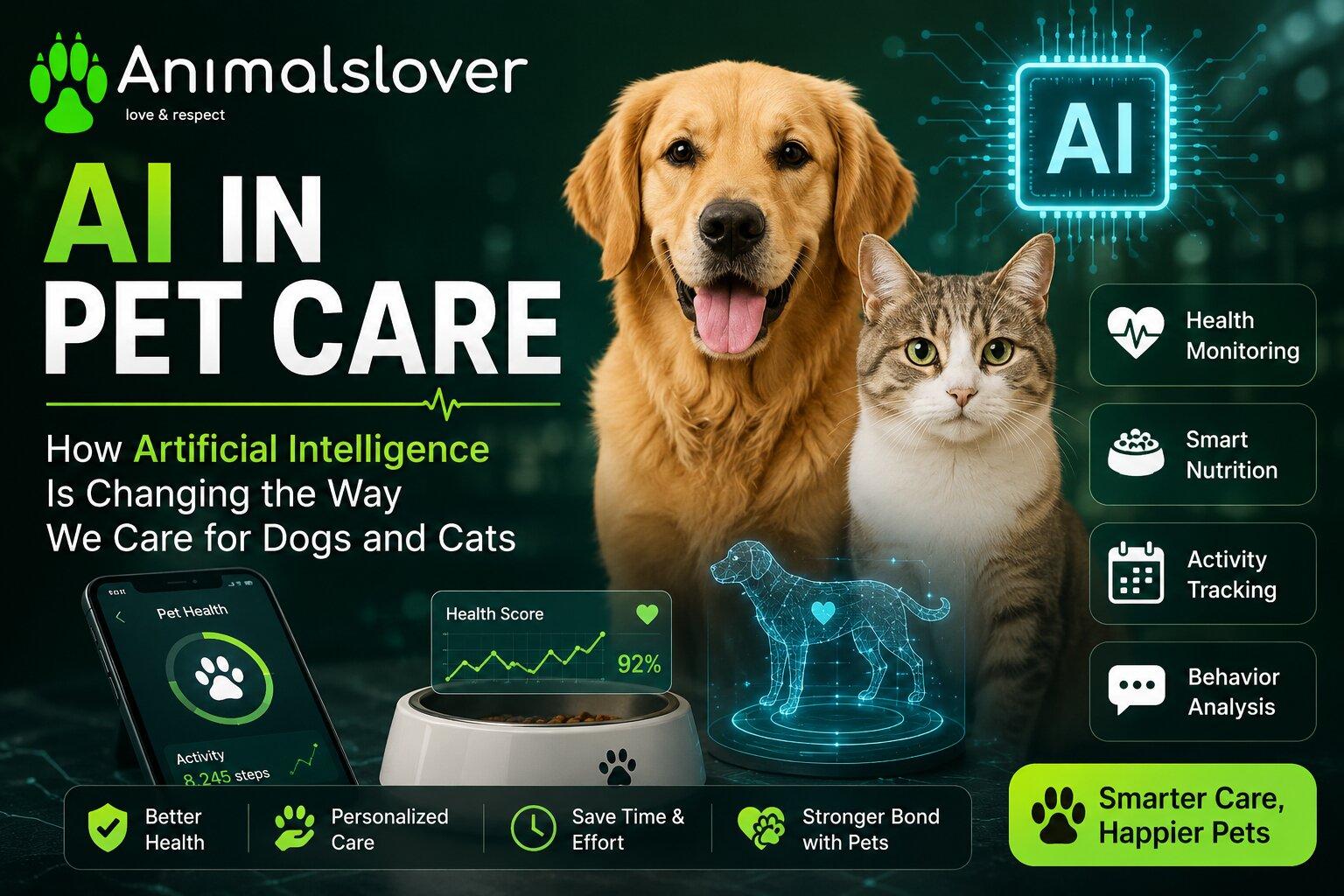
AI in Pet Care: How Artificial Intelligence Is Changing the Way We Care for Dogs and Cats
03 Sept 2026
Discover how AI is changing pet care through smart collars, health monitoring, veterinary technology, pet behavior tracking and modern tools for dog and cat parents.
We use AI to search for information, write emails, translate languages, plan trips and even organize our work.
Now, AI is slowly becoming part of pet care too.
From smart collars and pet cameras to digital health records and veterinary technology, new tools are making it easier to keep track of what our pets are doing and how their routine is changing.
For pet parents, this can be genuinely useful.
Imagine your dog normally spends a lot of time playing and walking around the house. Then, over several days, their activity drops.
You may not notice the change immediately.
A smart device might.
That doesn't mean the device knows exactly what is wrong. But it can give you a reason to pay closer attention.
And that's where AI could become really useful in pet care.
It can help us notice things.
It can organize information.
It can show patterns.
But it should never replace a veterinarian.
Let's look at how AI is changing pet care and what pet parents should actually expect from this technology.
What Does AI in Pet Care Mean?
The phrase "AI in pet care" can sound complicated, but the basic idea is pretty simple.
AI can look at a lot of information and find patterns.
That information might come from:
- Smart collars
- Pet cameras
- Activity trackers
- Feeding devices
- Health records
- Photos
- Videos
- Veterinary reports
- Medical images
- Weight records
- Behavior data
For example, a wearable device may collect information about your dog's daily activity.
Instead of showing you hundreds of numbers, AI can look at the data and tell you that your dog's activity has been consistently lower than usual.
That's much easier for a pet parent to understand.
But remember:
A change in activity is a signal, not a diagnosis.
Your dog could be tired, stressed, hot, recovering from exercise or dealing with a health problem.
You still need context.
How Can AI Help Pet Parents?
The biggest benefit of AI may be that it can help pet parents notice changes that are easy to miss.
We see our pets every day.
Because of that, small changes can sometimes happen so gradually that we don't notice them.
AI doesn't get distracted in the same way.
It can compare today's information with information from previous days or weeks.
That can be useful for things like:
- Activity
- Sleep
- Eating
- Drinking
- Movement
- Scratching
- Weight
- Bathroom habits
- General behavior
It doesn't mean AI knows everything about your pet.
It simply gives you another source of information.
Smart Collars Are Becoming More Useful
Most people think of smart collars as GPS trackers.
And yes, finding your dog when they run away is already a pretty useful feature.
But modern pet wearables are starting to do more.
Depending on the device, they may track things such as:
- Activity
- Rest
- Movement
- Sleep
- Location
- Some physiological information
- Behavior
Some newer systems are also experimenting with analyzing sounds, movement and body language.
The idea is interesting.
Instead of only asking:
"Where is my dog?"
technology is starting to ask:
"What is normal for this dog, and what has changed?"
That could become very valuable over time.
Can AI Tell If Your Pet Is Sick?
This is where we need to be realistic.
AI can help identify patterns.
It may notice that your dog is moving less.
It may notice that your cat is eating less.
It may recognize that your pet's routine is different.
But that's not the same as knowing what is wrong.
For example, a dog that is panting more could simply be hot.
Or excited.
Or nervous.
Or in pain.
Or experiencing another health issue.
The same behavior can have completely different causes.
That's why AI should be seen as an early awareness tool, not a doctor.
Think of it like this:
AI notices the change.
Your veterinarian investigates the change.
AI and Veterinary Care
AI isn't only being developed for pet owners.
Veterinarians can also use AI to help with their work.
One important area is medical imaging.
Veterinary teams use things like:
- X-rays
- CT scans
- Ultrasound
- MRI
- Dental imaging
AI can help analyze these images and highlight patterns that may deserve attention.
This could be especially useful when veterinary teams have a large number of images to review.
But the final decision still belongs with the veterinary professional.
A veterinarian looks at much more than one image.
They also consider the pet's:
- Age
- Breed
- Symptoms
- Medical history
- Physical examination
- Laboratory results
- Other health conditions
AI can be another tool in that process.
Can AI Analyze a Photo of Your Dog or Cat?
Some AI tools can analyze pet photographs.
You may have seen apps where you upload a photo and ask about:
- A skin mark
- Redness
- A wound
- A rash
- A swollen area
- Dental appearance
This can sometimes be useful as a starting point.
But there is a very big limitation:
A photo only shows what you can see.
It can't tell you everything happening inside your pet.
A dog can look completely normal in a photo and still have a serious internal problem.
So don't use an AI photo result as a reason to avoid seeing a veterinarian.
AI Can Also Help With Pet Behavior
Your pet can't explain what's going on.
They can't say:
"I'm stressed today."
They show us through behavior.
That's why behavior tracking could become an interesting area for AI.
Technology may eventually help identify changes in:
- Activity
- Sleep
- Vocalization
- Movement
- Eating
- Interaction
- Grooming
- Daily routine
For example, imagine your cat normally spends a lot of time playing in the evening.
Then suddenly, that activity disappears for several days.
A monitoring system could highlight the difference.
Again, it doesn't tell you the reason.
But it may help you notice that something has changed.
What About AI for Pet Nutrition?
Technology is also making feeding easier.
Smart feeders can help pet parents control:
- Meal timing
- Portions
- Feeding schedules
- Multiple pets
- Automatic meals
This can be especially useful if you work long hours or have a busy schedule.
AI could also help make feeding recommendations more personalized by considering things like:
- Age
- Weight
- Activity
- Lifestyle
- Feeding history
But don't assume that an AI recommendation is automatically the right diet for your pet.
A healthy adult Labrador and a senior cat with kidney disease clearly don't need the same feeding plan.
For pets with medical conditions, nutritional decisions should be discussed with a veterinarian.
AI and Pet Cameras
Pet cameras aren't new, but AI is making them more interesting.
A normal pet camera lets you watch your dog or cat.
AI could potentially go one step further by identifying patterns.
For example, a system may notice that:
- Your dog is barking repeatedly
- Your cat is spending more time hiding
- Your pet is pacing
- Your pet is unusually inactive
That could be useful for pet parents who spend several hours away from home.
Instead of watching hours of footage yourself, technology may eventually highlight unusual moments for you.
AI Can Make Pet Records Easier to Manage
This sounds boring compared with smart collars.
But it could actually be one of the most useful applications.
Think about all the information you collect over your pet's lifetime:
- Vaccinations
- Veterinary visits
- Medication
- Weight
- Test results
- Allergies
- Diet
- Previous illnesses
For many pet parents, these records end up scattered across paper files, WhatsApp messages, emails and photos.
A digital pet health profile can keep them together.
AI could then help organize or summarize that information when needed.
For example:
"Your dog received these vaccinations last year, has a history of this allergy and has gained 2 kg since the previous check."
Having that information ready can make conversations with your veterinarian much easier.
Can AI Help With Dog Training?
Yes, but in a different way.
AI can act like a training assistant.
You can ask for help with things like:
- Puppy training
- Potty training
- Leash pulling
- Puppy biting
- Barking
- Recall
- Basic commands
- Mental stimulation
For example, you might say:
"My puppy keeps biting my hands during play. What should I do?"
AI can give you a structured training routine.
That's useful for learning.
But serious behavior problems are different.
Aggression, severe anxiety, biting, dangerous reactivity or major behavior changes may need help from a veterinarian or qualified behavior professional.
What AI Still Cannot Do
This is probably the most important part of the entire article.
AI cannot replace:
A physical examination.
Blood tests.
Hands-on treatment.
Surgery.
Emergency care.
Professional veterinary judgment.
It also can't understand your pet as well as someone who has examined them directly and knows their medical history.
An AI app might give you ten possible causes of vomiting.
Your veterinarian can actually examine your dog, take a history, perform tests and decide what needs to happen next.
That's a huge difference.
The Problem With "AI-Powered" Pet Products
There's another thing pet parents should be careful about.
Just because a product says AI-powered doesn't automatically mean it is scientifically proven.
Before buying a smart pet device, ask:
What does it actually measure?
Don't focus only on the word AI.
Has it been tested?
Look for information about accuracy and validation.
Can I understand the results?
A simple useful report can be better than dozens of confusing numbers.
Can I share the data with my veterinarian?
That makes the information much more useful.
How much does it really cost?
Check for subscriptions or ongoing fees.
What happens to my pet's data?
Look at the company's privacy policy before uploading health information, photos or other personal data.
When Should You Ignore AI and Call the Vet?
Sometimes technology should simply stay out of the way.
If your pet is showing serious symptoms, don't spend an hour asking an AI chatbot what it could be.
Get professional help.
Examples include:
- Trouble breathing
- Collapse
- Seizures
- Severe injury
- Heavy bleeding
- Suspected poisoning
- Inability to urinate
- Loss of consciousness
- Extreme weakness
- Serious allergic reactions
In these situations:
Veterinary care comes first.
AI can wait.
7 Simple Ways Technology Can Help You Be a Better Pet Parent
You don't need a house full of smart gadgets.
A few simple tools can already be useful.
1. Keep digital health records
Store important veterinary information in one place.
2. Track your pet's weight
Regular measurements can help you notice changes.
3. Set reminders
Use your phone for vaccinations, medications, grooming and appointments.
4. Use a pet camera
It can help you understand what your pet does when you're away.
5. Try interactive feeding
Puzzle feeders can make meals more interesting.
6. Use activity tracking when it makes sense
Look for long-term trends instead of worrying about every little number.
7. Use AI to learn
Ask questions, prepare for vet visits and learn more about your pet—but verify important health information with professionals.
What Does the Future of AI Pet Care Look Like?
This is where things get really interesting.
Today, different systems usually collect different types of information.
A collar tracks activity.
A camera records behavior.
A feeder manages meals.
A veterinary clinic stores medical records.
In the future, these systems could potentially work together.
Imagine a digital health profile that brings together:
Activity + behavior + weight + food + medical history + veterinary records
AI could then look for meaningful changes across all of that information.
For example:
Your dog has slowly become less active.
They are sleeping more.
Their weight has changed.
Their eating pattern is different.
A system could potentially bring those changes together and tell you:
"Something about your dog's normal routine has changed."
That could encourage an earlier conversation with a veterinarian.
But getting to that point safely will require proper testing, good-quality data and responsible use of technology.
AI Should Help Us Understand Pets Better
The biggest benefit of AI may not be "AI diagnosing pets."
It may be something much simpler.
Helping us pay better attention.
Pets can't tell us when something feels different.
We have to notice.
And sometimes, we miss small changes simply because we see our animals every day.
Technology could help fill that gap.
But technology should support the relationship—not replace it.
Your dog still needs a walk.
Your cat still needs playtime.
Your pet still needs affection.
And when something feels wrong, they still need a veterinarian.
Frequently Asked Questions
Can AI diagnose my dog's illness?
AI can provide information and help identify patterns, but it should not be treated as a definitive diagnosis. A veterinarian may need to examine your dog and perform tests.
Can AI tell if my cat is unhappy?
Some technologies can analyze behavior and identify changes that may be associated with stress or discomfort. However, AI cannot reliably read a cat's emotions like a human mind reader.
Are smart collars useful?
They can be useful for tracking activity, location and other measurements. Their value depends on what the device measures, how accurate it is and how you use the information.
Can AI help with dog training?
Yes. AI can provide general training ideas and step-by-step routines for common problems. Serious behavior issues should be handled with help from qualified professionals.
Can AI monitor my pet while I'm away?
Some smart cameras and wearables can monitor activity and behavior. This can help owners notice unusual patterns when they aren't physically at home.
Should I trust an AI pet health app?
Use it as an information and preparation tool, not as a replacement for veterinary care.
Will AI replace veterinarians?
AI is much more likely to become a support tool for veterinarians than a replacement for them. Professional examination, diagnosis and treatment still require veterinary expertise.
Conclusion
AI is changing pet care, but the biggest changes may be happening quietly.
A smart collar can notice a change in activity.
A camera can show unusual behavior.
A digital record can make your pet's history easier to understand.
AI can help organize information.
Veterinary technology can help professionals work with medical images and other health data.
All of that can be useful.
But there's something technology can't replace.
You.
You're the person who knows that your dog normally runs to the door when you pick up the leash.
You're the person who knows that your cat normally sleeps on the sofa.
You're the person who notices when they're just a little different.
Use technology to help you notice those changes.
Use AI to learn.
Use smart devices when they genuinely make life easier.
But when your pet needs medical care, trust a qualified veterinarian.
Because the future of pet care isn't AI instead of humans.
It's pet parents, veterinarians and technology working together to give animals better care.
And that's a future worth getting excited about. 🐾
More Pet Care Guides From AnimalsLover
At AnimalsLover, we're building practical resources to help pet parents make better decisions every day.
Explore our guides on dog care, cat care, health, nutrition, grooming, training, breeds, pet travel, boarding and modern pet technology.
🐾 Did you enjoy this article?
Explore more pet care tips, breed guides and expert advice on our blog. For pet-related questions, contact our team.